In this post, I provide an overview for a general audience of my recent paper The Impact of U.S. Tariffs on European Public Opinion: Evidence From a Natural Experiment, which is forthcoming in the Journal of Experimental Political Science. The full paper (in preprint form) is available here.
I have used Claude Opus 5.5 to adapt the code for the figures and table from the paper’s replication package and to draft their captions. All narrative text is written by me, with minor grammar edits from Claude Opus 5.5
In early April 2025, the Trump administration announced a policy of near universal global tariffs. This included a 20% tariff against the European Union – one of the USA’s largest trading partners. The announcement followed typical Trumpian flourish, vividly painting an image of trade partners, both ally and enemy, as marauder like villains destroying the American dream:
The European Union, in turn, responded with typical EU flourish with Ursula von der Leyen emphasizing the goal of removing all trade barriers between the US and the EU, while gently expressing how Europeans were “let down by our oldest ally”. Of course, not all European leaders used this light touch diplomatic scolding, with German Economy Minister Robert Habeck calling the escalation a “an unprecedented attack on the international world trade system” , Prime Minister Pedro Sánchez calling them a “unilateral attack”, and French President Emmanuel Macron characterizing them as “brutal and unfounded”.1
This is a big change from previous administrations. The rhetoric used by the Trump administration emphasizes group borders. Trump characterized the US as being attacked by “foreigners,” while European politicians responded to this accusation by expressing feelings of being attacked and describing disappointment at being let down by a longtime ally.
In my paper, I argue that this event represents both an external threat to Europe and a breakdown of cooperation between allies.
In social science, we often talk about how in-groups and out-groups in various ways structure how we interact with each other. An in-group is a group you identify with (for instance being European) and an out-group is a group you don’t belong to. One way this plays out in politics is a “rally-around-the-flag” effect. When your in-group (nationality) is threatened, you become more nationalistic. Your attachment to the in group becomes stronger. At the same time, these threats might make you hostile to the group that you perceive as threatening you.2 In this case, I argue that this event would make Europeans more favorable towards the EU and less favorable towards the USA.
There is also a myriad of theories about why people cooperate with each other. Trade is one form of cooperation. Open trade depends on reciprocity. Both parties agree to trade with each other and not to put up trade barriers. I argue that Trump’s tariffs might do two things. First, Europeans might become more supportive of implementing tariffs of their own. Second, people might become less supportive of the trade system in general. After all, why would you support rules based open markets if one party ignores these rules?
But how do I actually study this? In the last decades of social science, there has been a shift in methodologies which is called the “credibility revolution” - which puts an increased emphasis on methodological rigor with a specific focus on causality using experimental or quasi-experimental methods.3 This means that there is less focus on looking at description - e.g. showing that positive attitudes of the United States have gone down in Europe over time, and more on showing that something causes another thing to occur – e.g. whether an announcement by Trump caused changes in Europeans’ attitudes.
Experiments can show that something caused an effect because people are randomly selected to receive an intervention (the treatment) and some who do not (the control). The randomness is key. It allows groups to be balanced on observed and unobserved characteristics. Therefore, any difference can be attributed to the treatment rather than pre-existing differences between the groups. Getting this type of randomness, where some groups are treated and others are the control, is difficult outside of an experimental setting.
In my paper, I use an “unexpected event during survey design”. This has become a popular design in political science. This approach uses survey data where we have information about the day of the interview, and an external news event. The logic of this design is that whether someone is surveyed before or after an event is as-if random. That means, under a set of assumptions, the difference between these groups can be viewed as the causal effect of the event.4
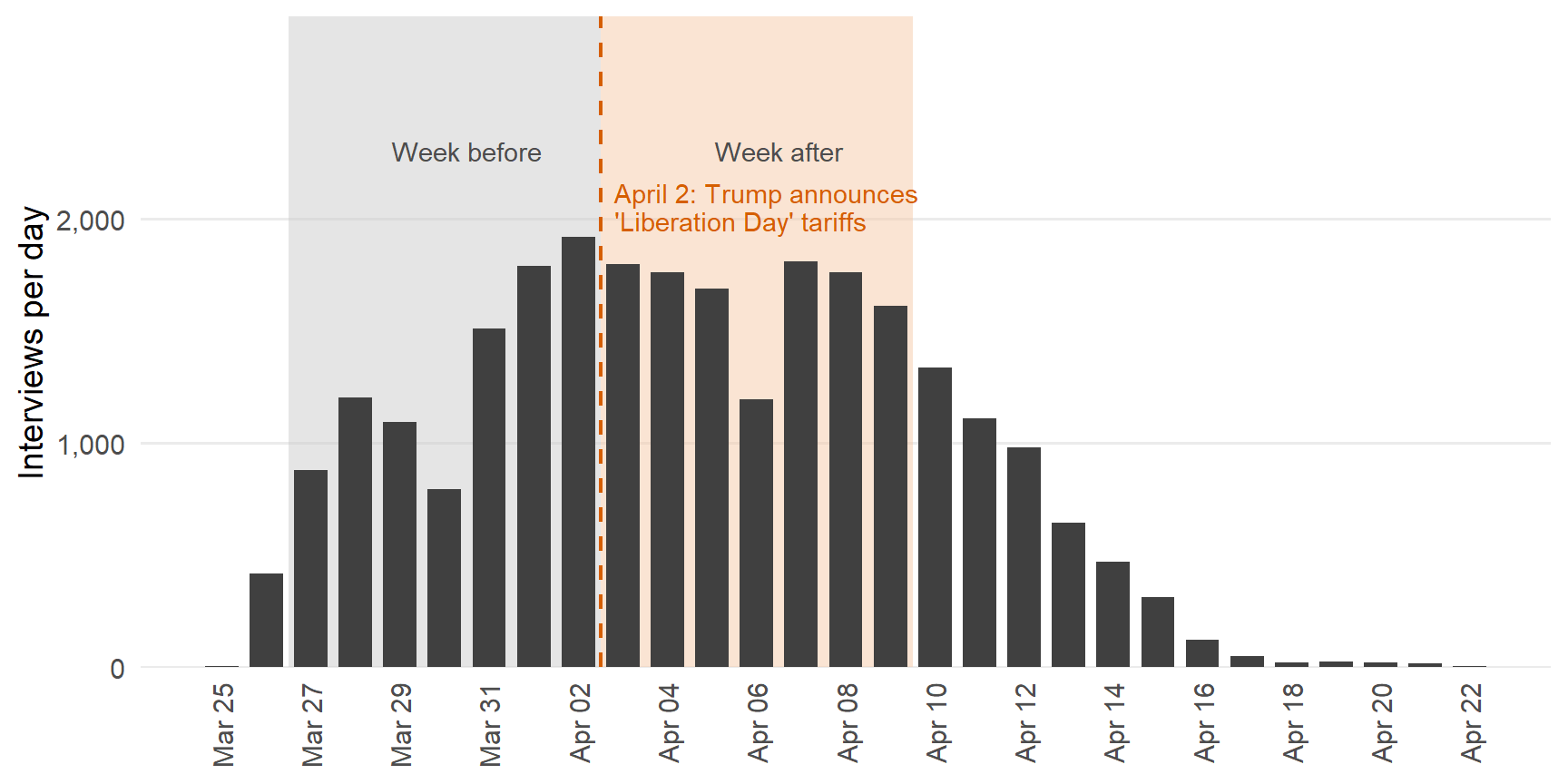
For my paper, I use the announcement of the “Liberation Day” tariffs, which occurred in the middle of the fieldwork for Standard Eurobarometer 103.3 (Spring 2025), a large survey conducted in every EU member state from late March to April 22, 2025. Figure 1 helps with the intuition. In essence, I compare people who were interviewed in the week before the announcement with people who were interviewed in the week after.
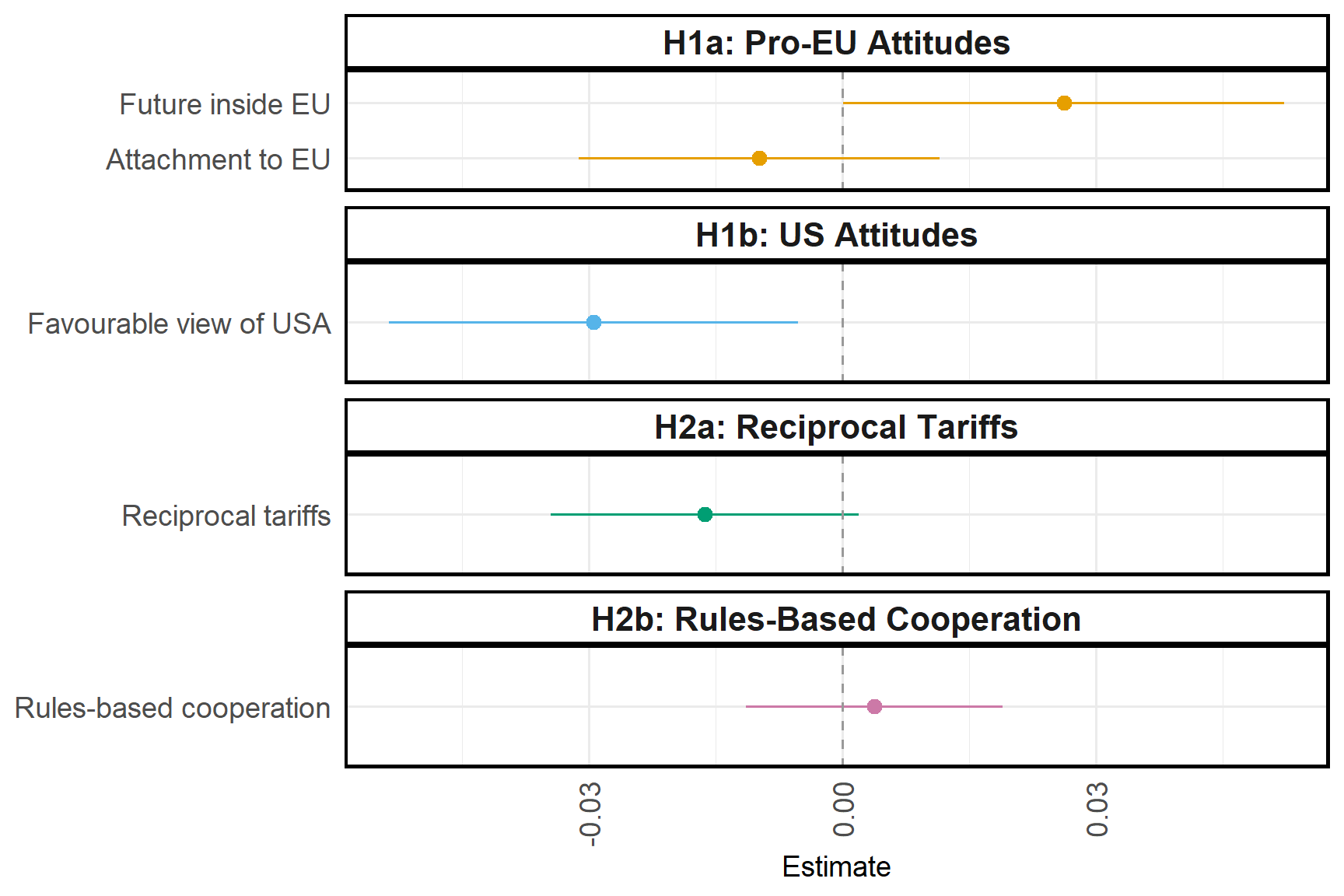
So, what did I find? Did Europeans become more supportive of the European Union? Did it make them more negative towards the United States? Did they shift their trade preferences? Mostly, there was very little change. The Trump tariffs did not make Europeans more attached to the EU, nor did they change attitudes towards trade.
The only hypotheses that was confirmed was a 2.9 percentage point decrease in favorable views of the United States. This is a small effect. Truthfully, I was expecting a larger effect for this question. On the other hand, in the control, only 33% had a positive view of the United States. It seems like positive attitudes towards the US were in short supply, even before Trump started a trade war.
Figure 2 plots the results. This is how you read it. The bottom axis (x axis) is the estimated difference between those interviewed before the announcement of tariffs and those after. The dots are the main estimates, which are, to simplify, the average difference between before and after. The thin lines are the 95% confidence intervals. I won’t get into the interpretation of these, but if the line crosses the dotted 0 line, we say that the effect is not statistically significant at the 5% level.
As a last analysis, I dug into the overall decrease in positive attitudes towards the United States. In the early analysis, I examined the difference between the pre- and post-announcement if the respondent had any positive attitude (either very positive or somewhat positive). In this analysis, I look at how each response category changed (very positive to very negative). The main finding is that there was an 3.8 percentage point increase in respondents having very negative view of the US after the announcement compared to before the announcement.
Table 1 shows the results. This is how you read the table. Each column is a response category. The row “After announcement” is the average difference before and after the announcement in the share of respondents selecting this answer.
| Response category | Main outcome | |||||
|---|---|---|---|---|---|---|
| Very positive | Somewhat pos. | Somewhat neg. | Very negative | Don't know | Positive (main) | |
| † p < 0.10, * p < 0.05, ** p < 0.01. Standard errors in parentheses. | ||||||
| Linear probability models with country fixed effects; standard errors clustered by country. | ||||||
| After announcement | -0.007† | -0.023† | -0.004 | 0.038** | -0.004 | -0.029* |
| (0.004) | (0.012) | (0.007) | (0.010) | (0.003) | (0.012) | |
| Num.Obs. | 20830 | 20830 | 20830 | 20830 | 20830 | 20830 |
One thing that was neat about this project was that I wrote most of the paper before seeing the data. This is called a registered report. The idea is that you write up your hypotheses and how you will do the analysis before you even have access to the data. This is usually hard to do with this type of data. But it was possible because there is a delay between the release of the Eurobarometer topline results (May 2025) and the release of the microdata from GESIS - Leibniz Institute for the Social Sciences (June 2026). The registered report format offered by the Journal of Experimental Political Science was perfect for this. It allowed me to register theoretically interesting hypotheses without myself or the reviewers being biased by the results. Reviewers were highly constructive and it was great to get their input early.
The figures and table above are produced from the replication package for the paper, using Eurobarometer 103.3 (March–April 2025, GESIS ZA9128, doi:10.4232/1.14782).
Footnotes
This is of course just one of many events in the first months of the second Trump administration that grabbed Europe’s attention. Other notable events included JD Vance’s speech at the Munich Security Conference where he implied that Europe’s greatest threats came not from external actors such as Russia or China, but rather from the European Union itself. This was followed shortly after by a contentious meeting between Ukrainian president Volodymyr Zelensky and members of the Trump administration.↩︎
As someone who started becoming aware of politics between 2001 and 2003 in the United States, let me say that I am predisposed to find this theory credible.↩︎
This is part of the reason why the 2021 Sveriges Riksbank Prize in Economic Sciences in Memory of Alfred Nobel was awarded to David Card, Joshua D. Angrist and Guido W. Imbens.↩︎
Testing these assumptions takes up like 43 pages of the appendix.↩︎